
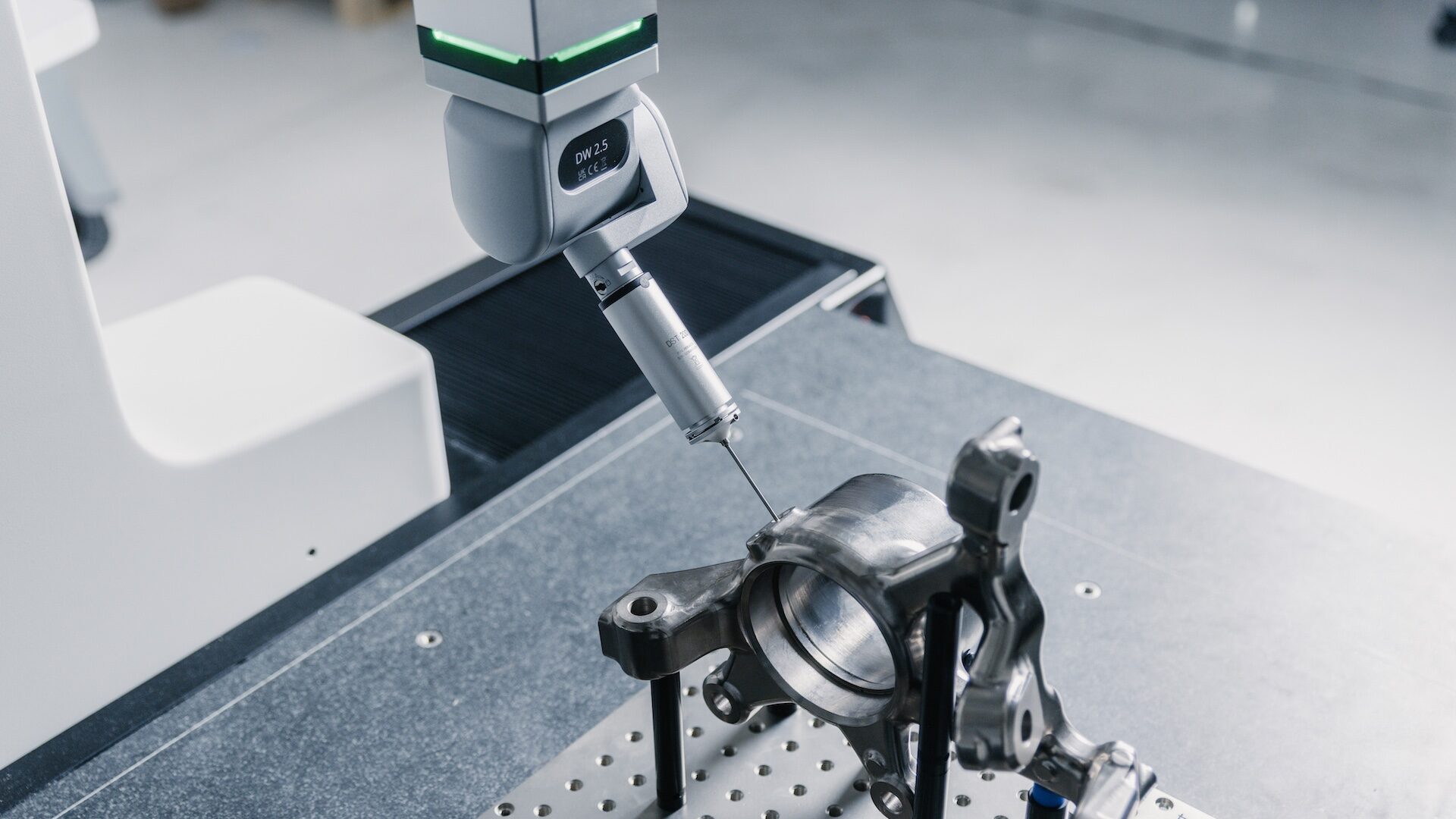
Bridge coordinate measuring machines remain the foundation of dimensional inspection in many manufacturing environments. Their repeatability, structural stability, and controlled measurement conditions make them well suited for a wide range of precision applications.
However, there are circumstances where a bridge or fixed CMM is not the optimal solution. The determining factors are rarely capability alone. They are typically driven by part scale, workflow, facility constraints, and inspection timing within the manufacturing process.
Part Scale and Structural Size
Certain components exceed the practical limits of a fixed CMM, both physically and economically. Examples include:
- Manufactured ship components
- Aircraft fuselage sections and structural assemblies
- Large agricultural, construction, or fire apparatus equipment
- Heavy fabrications, castings, and forgings
- Large-format additive manufactured parts

Airplane Fuselage In Construction
While gantry CMM systems can address size limitations, they introduce significant infrastructure considerations, including floor space, foundation requirements, and long-term facility allocation. For many operations, particularly those with variable production demands, portable metrology systems offer a more adaptable alternative.
In-Process and In-Fixture Inspection
In large-scale manufacturing, inspection frequently occurs while the part remains in a fixture or on a machine tool. Removing a component for laboratory inspection can compromise datum relationships and eliminate the ability to replicate the exact setup condition.
When parts are re-clamped, subtle variations may be introduced. In applications requiring corrective machining or alignment adjustments, duplicating the original condition becomes difficult. Portable measurement systems enable inspection to occur in place, preserving the manufacturing reference state, and reducing the risk of rework.
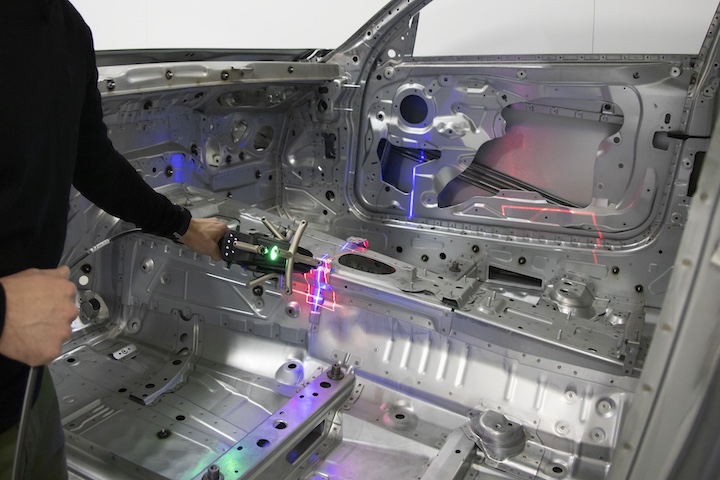
Portable Measuring System in Automotive Manufacturing Plant
Facility and Space Constraints
Bridge CMM installations require dedicated space, environmental control, and vibration isolation. In facilities where floor space is prioritized for production throughput, allocating real estate to a fixed inspection lab may not be feasible.
Portable systems reduce infrastructure requirements and allow inspection capability to be deployed without significant facility modification.
Throughput and Material Handling
A substantial portion of manufacturing costs are tied not to machining or fabrication, but to material movement. Transporting large components between production and inspection areas introduces handling time, labor cost, and scheduling delays.
Bringing measurement capability to the production floor reduces non-value-added movement and shortens the feedback loop between fabrication and inspection. This approach can improve throughput while minimizing disruption to workflow.
Accuracy Requirements and Application Fit
Not all applications demand the highest achievable laboratory accuracy. Where tolerance requirements are less restrictive, portable metrology solutions can provide sufficient precision while offering greater flexibility and lower overall capital investment.
Matching inspection capability to actual tolerance requirements is essential. Over-specifying inspection equipment may introduce unnecessary cost and operational complexity.
Distributed Manufacturing and Virtual Assembly
In many industries, large assemblies are manufactured in sections across different areas of a facility, or even across multiple plants. Portable measurement systems allow dimensional data to be captured in each location and digitally combined for virtual assembly analysis.
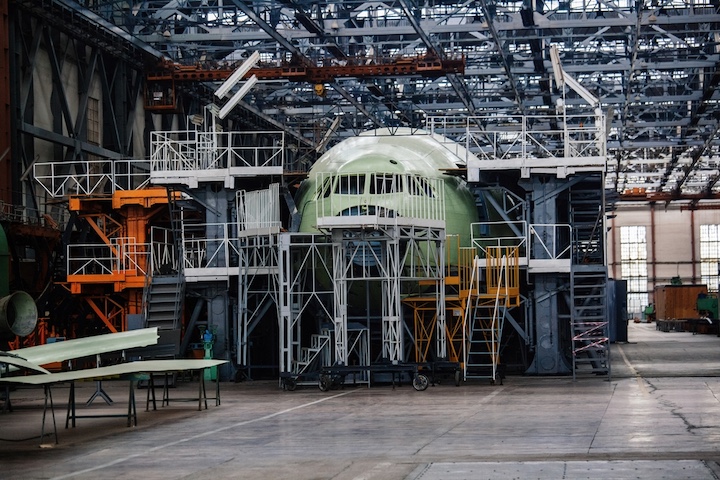
Process of Assembling of Aircraft in the Factory
By validating fit and alignment prior to physical integration, manufacturers can reduce rework risk and avoid costly field corrections.
Bridge CMMs remain a critical component of modern inspection strategy. However, they are not universally applicable.
Selecting the appropriate measurement solution requires evaluation of part size, inspection timing, facility constraints, accuracy requirements, and overall workflow impact. When these factors are not aligned with a fixed CMM installation, portable or in-process metrology may provide a more effective solution.
In dimensional inspection, the optimal tool is defined by the application – not by convention.
If your 2026 purchase planning is underway, Exact Metrology can help you select a measurement system fit for your workflow processes.
For more information or to schedule a site visit, contact us today.