
Introduction
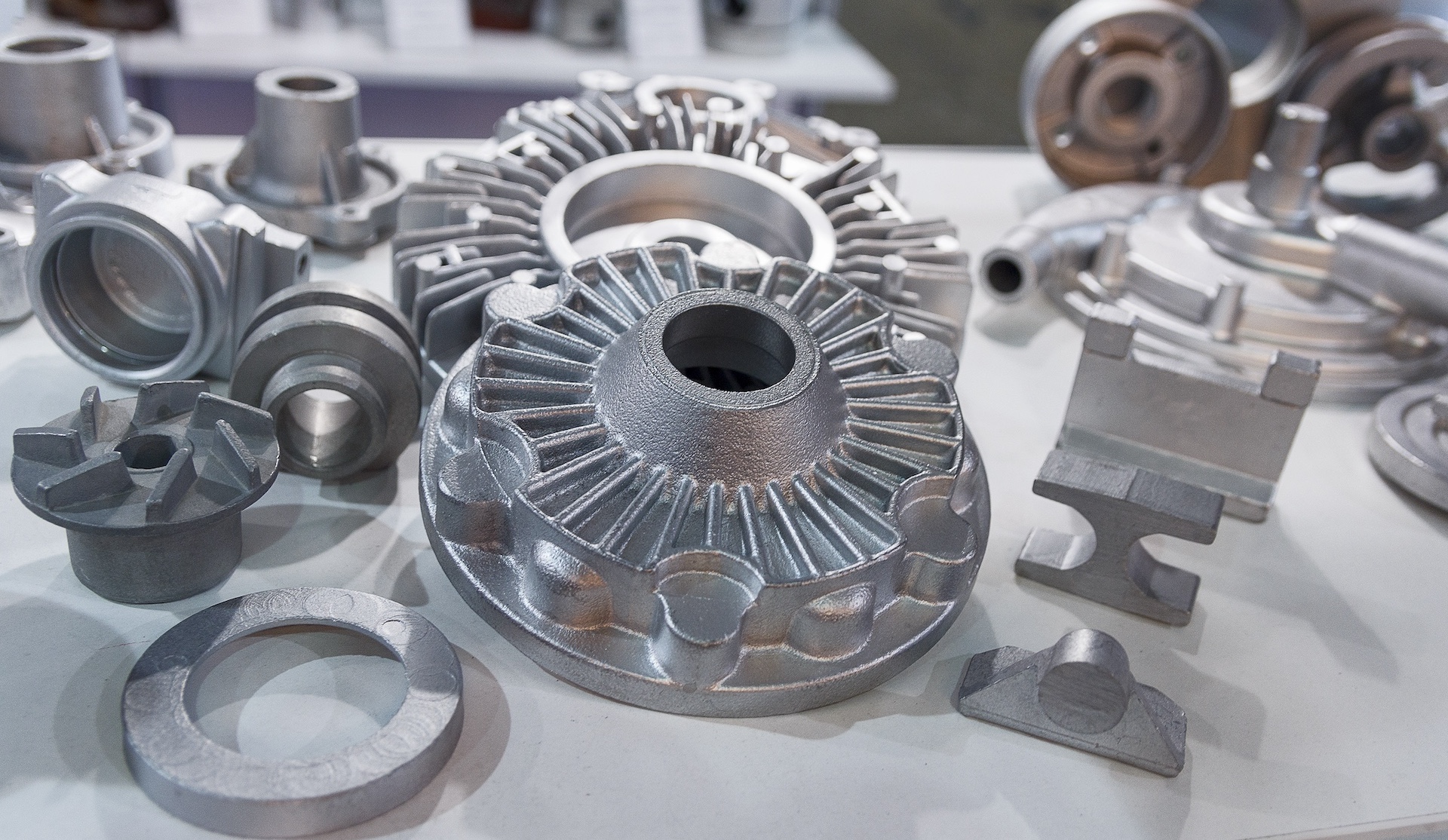
Foundries operate in a high‑stakes manufacturing environment where quality, reliability, and production efficiency must align. While casting technology has advanced significantly, one challenge remains constant: many of the costliest defects occur inside the part.
Porosity, shrinkage, inclusions, and internal geometry deviations often remain hidden until machining, pressure testing, or field performance exposes the problem. By the time these issues appear, manufacturers have already invested significant time and cost into the component.
Industrial CT scanning provides a new level of visibility. By capturing a complete three‑dimensional dataset of a casting, engineers can inspect internal features, quantify defects, and verify geometry without destroying the part. This allows foundries to identify problems earlier, validate process changes faster, and reduce the risk of costly downstream failures.
“You don’t fail on geometry. You fail internally.”
Where Traditional Inspection Fall Short
Many foundries rely on visual inspection, dimensional metrology, and destructive testing to evaluate casting quality. While these tools provide useful information, they also leave significant blind spots.
Visual inspection cannot reveal internal defects. Destructive testing sacrifices valuable parts and provides information from only a single slice of the component. Conventional X‑ray inspection may reveal some internal features but often lacks the volumetric detail needed for full defect analysis.
As casting designs become more complex, these limitations become increasingly significant.
The Most Expensive Casting Defects Are Invisible
Many casting defects occur internally and cannot be detected through surface inspection.
- Porosity clusters
- Shrinkage cavities
- Core shift
- Wall thinning
- Blocked internal passages
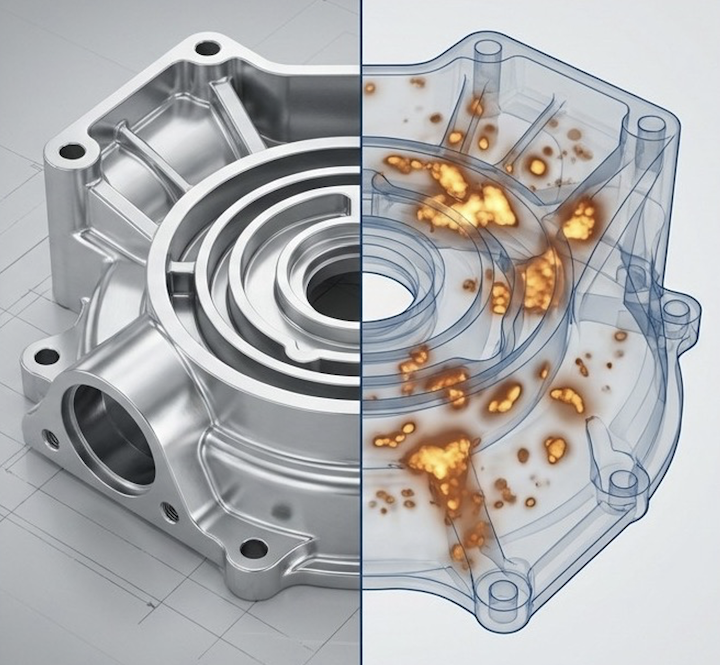
Example of Porosity Clusters
What CT Scanning Provides
Industrial CT scanning creates a full volumetric dataset of the component. Engineers can analyze internal and external features with a high level of precision.
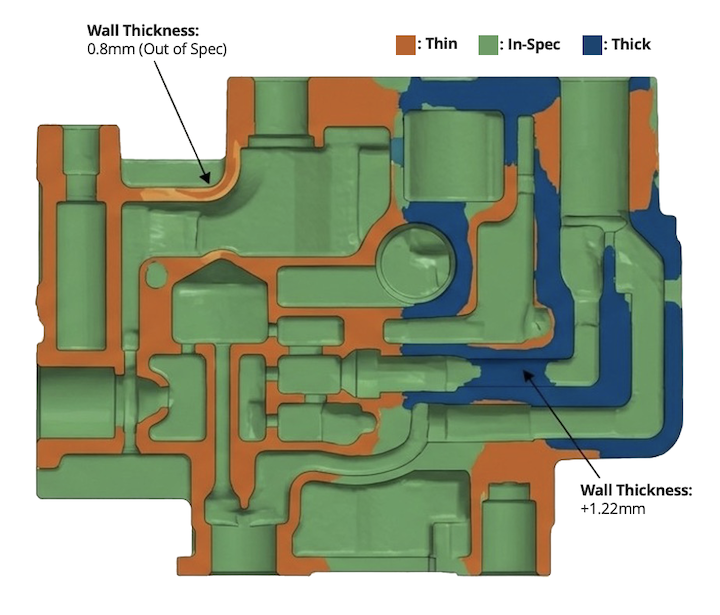
Wall Thickness Verification
CT scanning enables foundries to:
- Measure and quantify porosity distribution and volume
- Verify wall thickness and internal passages
- Detect core shift and internal misalignment
- Compare scan data directly against CAD models
- Generate accurate reverse engineered models of legacy castings
This information allows engineers to diagnose problems earlier and correct process variables faster.
Porosity Analysis and Process Optimization
Porosity remains one of the most common causes of casting failure. CT scanning allows foundries to measure the exact location, size, and volume percentage of both gas and shrinkage porosity.
By mapping defect clusters and correlating them with gating design, riser placement, or cooling conditions, engineers can make data‑driven process adjustments.
“A CT scan isn’t just an image. It’s a complete digital dataset engineers can analyze from every angle.”
Verifying Internal Geometry
Core shift, blocked passages, and wall thinning can compromise casting performance and reliability. These issues may not become apparent until machining or functional testing.
CT scanning verifies these internal features directly and provides detailed deviation analysis compared to CAD models. Engineers can confirm whether the casting matches design intent before additional manufacturing steps occur.
Root Cause Analysis for Field Failures
When a component fails in service, identifying the root cause quickly is critical. CT scanning allows engineers to pinpoint crack origins, subsurface defects, or internal voids without destroying the part.
This provides clear evidence that supports corrective action and prevents repeat failures.
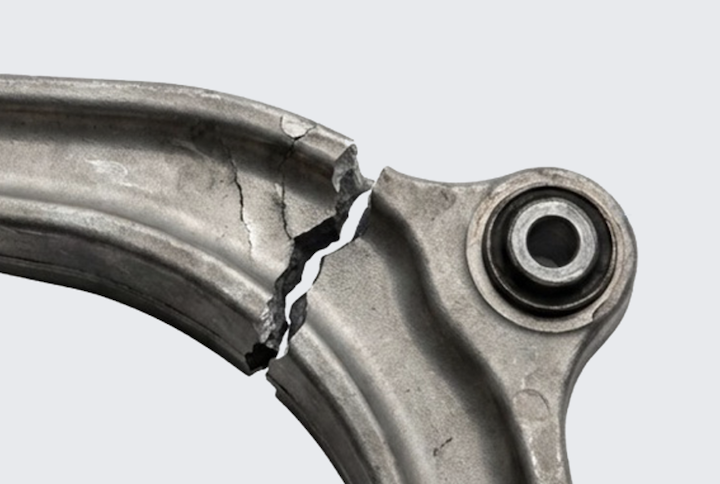
The Failure
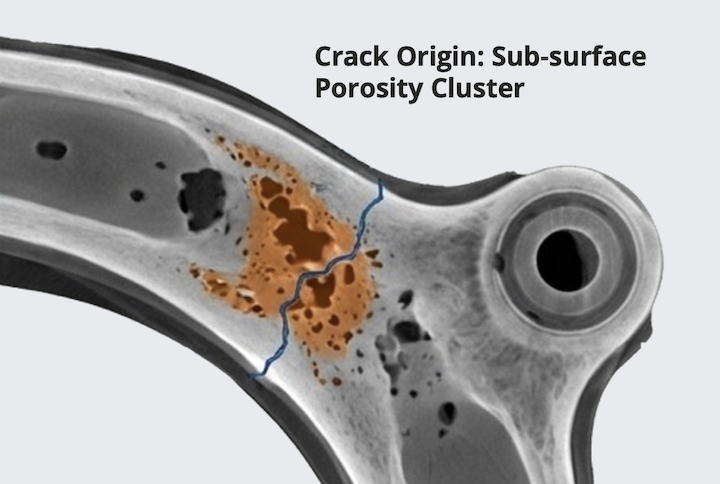
The Evidence
Reverse Engineering Legacy Castings
Many manufacturers continue producing legacy components with incomplete drawings or outdated CAD models. CT scanning allows engineers to capture the true internal geometry of an existing casting and generate accurate digital models for redesign, validation, or documentation.
CT Scanning vs Destructive Testing
- Sacrifices sellable parts
- Provides limited two‑dimensional data
- Information cannot be reused
- Preserves the physical part
- Provides full three‑dimensional volumetric data
- Supports inspection, analysis, and reverse engineering
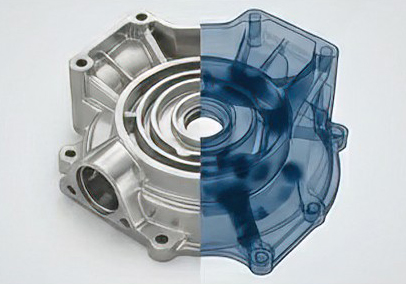
CT Scan of Part
Conclusion
As casting designs grow more complex and performance expectations increase, internal inspection is becoming more important across foundry operations.
Industrial CT scanning allows manufacturers to move beyond limited inspection methods and gain full visibility into internal structures and defects. By integrating CT scanning into development, validation, and production workflows, foundries can reduce costly rework, improve yield, and deliver more reliable components.
Instead of discovering defects after machining or field failure, CT scanning allows engineers to make informed decisions based on measurable internal data.
Exact Metrology: Your Partner in Advanced Inspection Solutions
At Exact Metrology, we’re committed to providing cutting-edge CT scanning services to help your business achieve its quality and performance goals. Whether you’re developing complex aerospace components, ensuring medical device safety, or optimizing 3D-printed designs, we have the expertise and technology to support your needs.
Contact us today to learn how our Industrial CT Scanning services can transform your parts inspection process and help you tackle your toughest challenges.